
Early access opening soon for software development companies
Run every software project with a clear, AI-powered lifecycle.
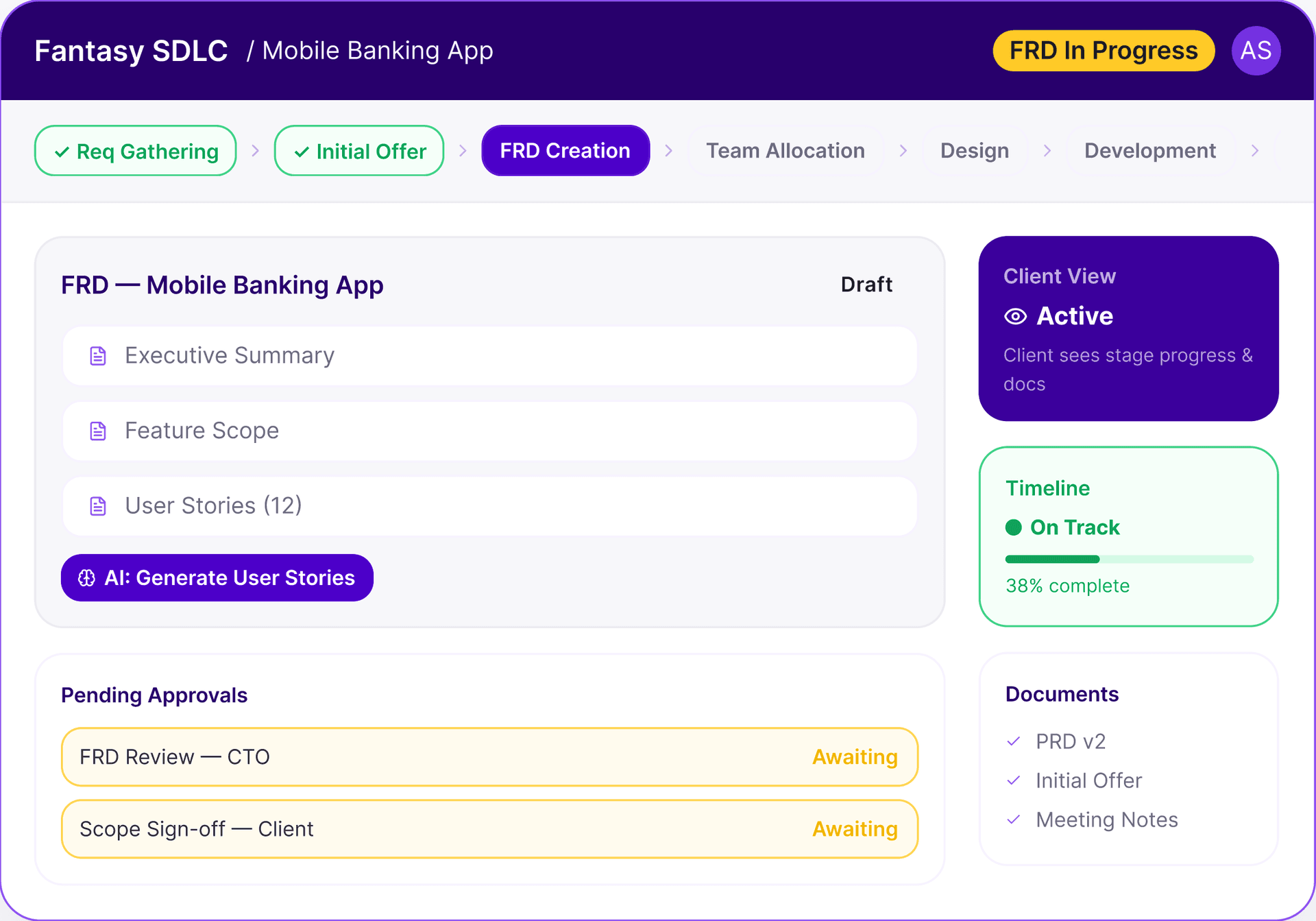
Fantasy SDLC helps software companies manage project stages, documentation, approvals, team handoffs, AI-generated project materials, and client transparency in one structured operating layer - without replacing Jira, Asana, Monday.com, or ClickUp.
*Built from Fantasy Space's real software delivery process, templates, and project management standards.
Software delivery is not broken because teams lack tools.
It is broken because project knowledge, documentation, approvals, client communication, and delivery processes are spread across too many disconnected places — or not standardized at all.
Many software teams do not follow one repeatable delivery process across all projects, so the software development lifecycle changes from project to project depending on the skills, habits, and experience of the people involved.
Project information is scattered across Jira, Google Docs, Slack, Figma, email, spreadsheets, and folders.
Clients repeatedly ask where the project stands, what is completed, what comes next, and what is waiting for approval.
PMs spend hours creating PRDs, FRDs, user stories, acceptance criteria, status updates, and project summaries manually.
Sales, PMs, designers, developers, DevOps, and clients often lose context during handoffs.
Deadlines slip, but clients do not clearly see why the project is delayed or what is blocking progress.
After launch, documentation becomes difficult to find and support becomes slower.
Not another task manager. The missing SDLC layer above your task tools.
Your team can keep using Jira, Asana, Monday.com, ClickUp, Slack, Figma, Google Docs, Drive, and the tools it already knows. Fantasy SDLC does not replace them. It works as the structured umbrella layer above your existing software delivery tools — connecting tasks, documents, approvals, responsibilities, AI assistance, and client visibility into one repeatable lifecycle.
Most tools help teams manage separate parts of the project. Fantasy SDLC helps the company connect those parts into one clear operating system for software delivery, so every project follows the same structured path instead of changing from project to project based on the habits, skills, or experience of individual team members.
Process definition
Team/PM defines their own
Standardized lifecycle for every project
Scope of management
Individual tasks & sprints
Full project lifecycle & stage progress
Context for tasks
Task descriptions only
Linked to requirements, docs & stages
Tool relationship
Used separately for tasks, documents, design, communication, and files
Connects existing tools into one structured delivery layer
Status tracking
Task statuses
Stage completion, approvals, blockers, next actions
Client access
Internal execution only
Internal + transparent client view
Documentation
Some context in descriptions
PRD, FRD, TRD, design links, deployment docs
AI support
Manual creation required
AI drafts, user stories, summaries, suggestions
Built for software companies that want predictable delivery, not project chaos.
Fantasy SDLC gives every project a clear structure, every role a clear next step, and every client a transparent view of progress.
Standardize project delivery
Give every PM the same lifecycle stages, checklists, templates, approvals, and documentation standards.
Reduce manual PM work
Use AI-assisted workflows to draft Pre-FRDs, FRDs, user stories, acceptance criteria, task descriptions, summaries, and status updates.
Improve client trust
Show clients what is completed, what is active, what is pending, what comes next, and what documents are available.
Keep knowledge centralized
Connect requirements, designs, decisions, technical notes, deployment instructions, and support materials to one project space.
Improve team handoffs
Help sales, PMs, designers, developers, DevOps, CTOs, and clients understand the same project context.
Identify risks earlier
Track missing documents, pending approvals, delayed stages, blockers, and timeline trendlines before they become bigger problems.
One connected workspace for the full software development lifecycle.
From the first client conversation to documentation, planning, delivery, launch, and support — Fantasy SDLC keeps project knowledge structured and visible.
Stage-Based Project Workspace
Create a project lifecycle with stages, responsible people, actions, checklists, documents, approvals, AI suggestions, and completion status.
Central Documentation Hub
Store PRD, FRD, TRD, sitemap, design links, agreements, timelines, meeting notes, technical guidelines, deployment instructions, and support docs in one organized place.
AI Project Assistant
Generate draft documentation, convert requirements into EPICs and user stories, create acceptance criteria, summarize meetings, and answer questions from project documents.
Client Transparency Portal
Give clients a simplified view of the project: current stage, completed work, active work, next steps, approvals, documents, and timeline status.
PMO Dashboard
See project health, bottlenecks, missing documents, pending approvals, resource allocation, and stage completion across multiple projects.
Tool Integrations
Push generated EPICs, user stories, acceptance criteria, and task descriptions into existing tools like Jira, Asana, Monday.com, or ClickUp.
Give clients clarity without exposing your internal chaos.
Clients do not need to see every internal task. They need to understand where the project is, what is completed, what is active, and whether it is on track.
Fantasy SDLC turns project progress into a simple, understandable client view. It helps software companies communicate honestly, manage expectations earlier, and reduce repeated status questions.
Awaiting Your Approval
FRD Sign-off
Documents Available
3 Files
AI that understands the software delivery process.
Fantasy SDLC uses supervised AI to reduce repetitive PM work, structure project information, and help teams move from business requirements to technical execution faster.
Human expertise leads. AI accelerates. The responsible person reviews, edits, and approves.
- 01
Create PRD drafts from client conversations and initial project notes.
- 02
Generate FRD draft sections from requirements, references, and PRD.
- 03
Support TRD creation and technical requirement organization.
- 04
Create sitemap structures and feature breakdowns.
- 05
Convert requirements into EPICs, user stories, acceptance criteria, and task descriptions.
- 06
Push EPICs, user stories, and tasks into Jira, Asana, Monday.com, or ClickUp with one click.
- 07
Summarize project status for internal teams and clients.
- 08
Identify missing information, missing approvals, or unclear requirements.
AI Assistant — FRD Generation
Prompt: Generate user stories from approved requirements for the authentication module.
US-01: As a user, I want to log in with email and password so that I can access my account securely.
US-02: As a user, I want to reset my password via email so that I can recover access if I forget it.
US-03: As an admin, I want to enable 2FA for users so that account security is enhanced.
A clear stage-based workflow from first client call to delivery.
Each project stage includes responsible people, actions, checklists, document templates, approval points, AI support, and stage results.
Project Discovery & Definition
Result: Clear project scope, approved requirements, and readiness for team allocation.
Design & Planning
Result: Allocated team, approved design direction, technical plan, and development-ready backlog.
Development & Agile Execution
Result: Features developed, tested, reviewed, and prepared for release through structured Agile delivery.
Deployment & Launch
Result: Product deployed, launched, validated, and ready for real users.
Post-Launch Support & Improvement
Result: Project remains maintainable, supported, and ready for future growth.
Built for software teams that need a repeatable delivery process.
Fantasy SDLC is designed for small and mid-sized software development companies that manage several client projects and want every project to follow a clearer, more consistent lifecycle.
Capability
Up to 100 employees
Software development companies
Up to 10 people
Per project team
Teams managing several client projects at the same time.
Companies already using Jira, Asana, Monday.com, ClickUp, Slack, Figma, Google Docs, or similar tools.
Teams that struggle with documentation, approvals, handoffs, client updates, and process consistency.
Companies where the delivery process changes from project to project depending on the PM, team lead, or team experience.
Companies that want a clear SDLC structure without adding enterprise-level complexity.
Project Managers
Move from stage to stage without missing actions, documents, or approvals.
PMO / Head of PMs
Oversee multiple projects, health, bottlenecks, and resource allocation.
Sales Managers
Transfer the sales conversation into a structured PRD and evaluation.
CTOs / Tech Leads
Review feasibility, TRD structure, architecture, and development guidelines.
Developers
Understand requirements, priorities, and the larger project context behind tasks.
Designers
Follow structured design stages with access to requirements and references.
DevOps Engineers
Access deployment requirements, environments, CI/CD, and release checklists.
Clients
See a transparent view of project status, completed work, and documents.
Join the early access group and shape the future of software delivery.
We are opening early access for selected software development companies that want a more structured, transparent, and AI-assisted delivery process.
Early access companies can receive 50% off the first year and a free 1-month trial.

Early Access
Get access before the public launch and set up your team's delivery process first.

50% First-Year Discount
Receive a first-year discount for selected early access companies.

Free 1 Month Trial
Test the product with real projects during a free trial period.
Early access slots are limited so the Fantasy Space team can onboard, learn from, and support each selected company properly.
Built from real software delivery experience.
Fantasy SDLC is based on Fantasy Space's internal software development experience, project management standards, documentation templates, process knowledge, and AI automation practices.
The product is not being designed as a generic project management experiment. It is being shaped around real problems that software companies face when managing client projects: scattered knowledge, inconsistent documentation, unclear handoffs, missed approvals, and clients who need more transparent progress updates.
Based on
Fantasy Space delivery experience
We structured it into
Templates, standards & delivery processes
We enhanced it with
AI Assistance layer
And created
A universal SDLC platform for software companies
Common questions answered.
No. Fantasy SDLC is designed to work above these tools. It manages the lifecycle, documents, approvals, templates, AI assistance, and client transparency while task management tools continue handling execution boards and assignments.
It is built for software development companies, especially small and mid-sized teams up to around 100 employees that manage several client projects at the same time.
No. PMs are primary users, but the platform also supports PMO, sales, CTOs, technical leads, developers, designers, DevOps engineers, company leaders, and clients.
It solves the lack of a centralized, structured software delivery lifecycle. It connects stages, documents, approvals, responsibilities, AI-generated project materials, and client visibility.
AI assists the responsible team member. It can draft documents, generate user stories, summarize status, identify missing information, and answer questions from project documentation. Human review and approval remain part of the workflow.
The client view is simplified. Clients see project progress, documents, approvals, next steps, and timeline health — not every internal task or internal team discussion.
Fantasy SDLC is currently in the internal testing phase. We are using this early access period to validate the product with selected software companies, collect final feedback, and make the most important improvements before the public launch. After receiving final comments from early clients and completing the necessary refinements, we expect to be ready for launch within approximately 2 months.
The proposed validation offer is a free 1-month trial and a 50% first-year discount for selected early access companies, depending on final eligibility and business terms.
Ready to bring structure, transparency, and AI assistance into your software delivery process?
Apply for Fantasy SDLC early access and help us shape a platform designed specifically for software development companies.